
How Local Businesses Help Preserve Porter Ranch’s Neighborhood Character
How do local businesses help preserve the character of established neighborhoods like Porter Ranch?
Local businesses serve as the connective tissue of community life in Porter Ranch, creating gathering spaces, reflecting cultural identity, and keeping dollars circulating locally to strengthen the neighborhood’s self-contained suburban feel.
Why This Matters Right Now in Porter Ranch
Porter Ranch is not just another suburb. It is a collection of distinct sub-markets stacked into the northwest San Fernando Valley hillsides, and its identity has been shaped over decades by the people who live and work here. With a median sold price of $1,230,000 across 222 closings tracked through September 2026 (per Resideline), this is a community where homeownership is the norm, with roughly 86% of residents owning their homes according to Niche.com demographic data.
That high rate of ownership means you are surrounded by neighbors who are invested, literally and emotionally, in what happens on your street. And the local businesses that serve this community play an outsized role in maintaining the character that attracted those homeowners in the first place. Having built my business in Porter Ranch over the course of 21 years and more than 500 closed transactions, I can tell you: the neighborhoods where local commerce thrives are the neighborhoods that hold their value and their identity.
The Vineyards at Porter Ranch: A Case Study in Community Commerce
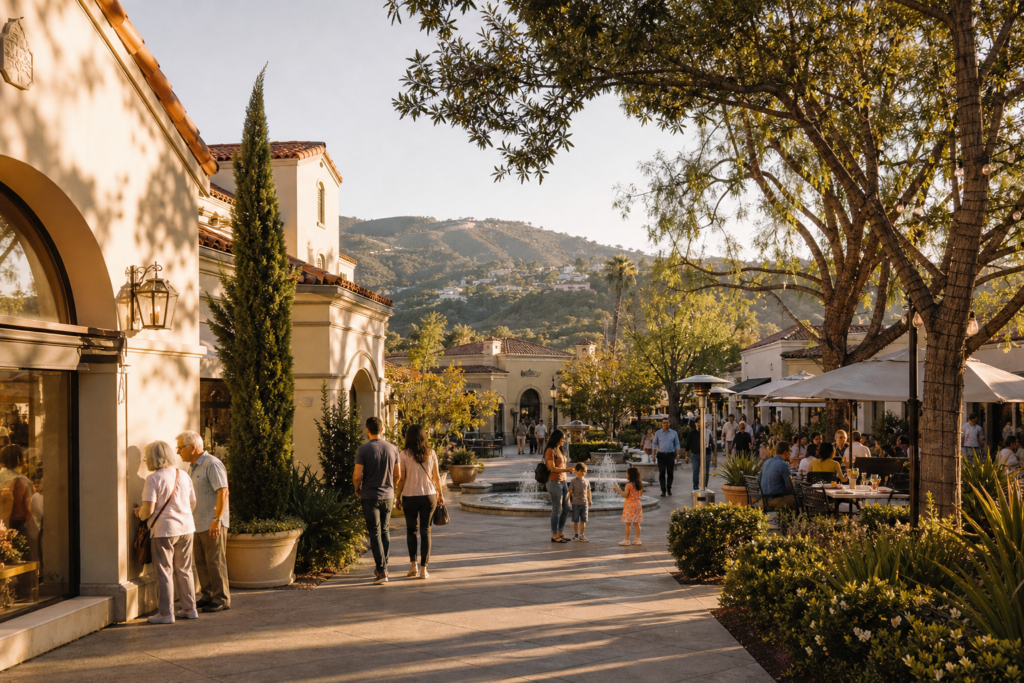
If you have spent any time in Porter Ranch, you already know The Vineyards. Located at Rinaldi Street and Porter Ranch Drive, this open-air shopping, dining, and community destination is the social heart of the neighborhood. It features a 4,000-square-foot community room, generous outdoor spaces, and a walkable “Main Street” design that can even close to vehicle traffic for special events.
What makes The Vineyards different from a typical strip mall? It functions as a genuine gathering place. Finney’s Crafthouse and Kitchen becomes the default neighborhood hangout for craft beer and casual dinners. Peet’s Coffee is the morning anchor where you will see the same faces week after week. Gus’s BBQ, Lure Fish House, La Popular, and Salina round out a dining scene that keeps residents from ever needing to leave the community.
Walk down Rinaldi on a Saturday morning and it does not feel like LA. It feels like a self-contained town. That is not an accident. It is what happens when a commercial center is designed around the community rather than around highway traffic.
What I tell my clients who are relocating from other parts of Los Angeles is this: the presence of a walkable, locally anchored commercial core is one of the clearest signals that a neighborhood has staying power. It is a feature that shows up in property values even if it never appears on a spec sheet.
How Porter Ranch’s Cultural Businesses Define the Neighborhood
You might not realize how culturally diverse Porter Ranch is until you look at the businesses that serve its residents. According to demographic data from City-Data, the neighborhood has notable Armenian (16.8%) and Russian (5.1%) ancestry populations, along with significant Korean, Filipino, Iranian, and Lebanese communities. In fact, 5.6% of residents primarily speak Korean at home, which is higher than 99.1% of neighborhoods nationwide.
These demographics are not just statistics. They are reflected in the bakeries, grocers, restaurants, and service providers that line the commercial corridors near Rinaldi and along the Route 118 corridor. Middle Eastern bakeries, Korean barbecue spots, and Armenian delis are not interchangeable with national chain alternatives. They carry specific culinary traditions, employ local residents, and create gathering spaces where cultural identity is maintained across generations.
Research from the Anti-Displacement Project highlights that legacy business programs exist specifically because longtime businesses that serve ethnic communities act as economic footholds for new immigrants and preserve neighborhood culture, identity, and social fabric. In Porter Ranch, these businesses do that work organically every day.
So why does this matter to you as a homeowner or prospective buyer? Because a neighborhood’s commercial identity is part of what makes it irreplaceable. When every business could exist in any zip code, the zip code itself starts to feel less distinctive. Porter Ranch’s cultural businesses are part of what makes this community feel like its own city rather than just another LA neighborhood.
The Economic Multiplier Effect and Your Property Values in Porter Ranch
Here is a number that should change how you think about your Saturday errands: for every $100 spent at an independent local shop, approximately $50 recirculates within the community, according to research compiled by Honest Modern’s economic analysis. That same $100 spent at a large national chain? Only about $15 stays local.
What does that actually mean for you as a Porter Ranch homeowner? It means the money you spend at local businesses funds the local soccer league sponsorship, the PTA donation, the scholarship for a graduating senior at a nearby high school. Local business owners tend to be deeply embedded in the communities where they operate. They live here, their kids go to school here, and they care about what happens here.
With a median household income of $158,590 (per Niche.com demographic data), Porter Ranch residents have significant purchasing power. When that purchasing power is directed toward local businesses, it creates a virtuous cycle: local spending sustains local businesses, those businesses sponsor community events and maintain neighborhood character, and that character, in turn, supports strong property values. In a market where prices were up 3.3% year-over-year as of June 2026 according to Resideline data, the economic health of your local commercial ecosystem is not a minor consideration.
Why Local Businesses Create Accountability That National Chains Cannot
A locally owned business owner is your neighbor. They send their children to the same schools. They attend the same events at the 50-acre community park or at Porter Valley Country Club on Singing Hills Drive. They have a stake in the community’s reputation that extends far beyond business hours.
This matters in ways both obvious and subtle. When a local contractor does poor work on a remodel in one of the gated communities above Sesnon Boulevard, word travels fast. Reputation is currency in a close-knit community like this, and that social accountability creates a standard of service that is hard to replicate with a national brand where the nearest regional manager is three states away.
As someone who has helped clients throughout Upper Porter Ranch navigate everything from new construction negotiations with Toll Brothers in Westcliffe and Hillcrest to resale listings on the Rinaldi Corridor, I see this accountability principle reflected in my own work. With over 103 client reviews and a 5.0 out of 5 average rating, I understand that in a community like Porter Ranch, your reputation follows you home. That is the same dynamic at play for every locally owned business in the neighborhood.
What Happens When Local Businesses Disappear from Established Neighborhoods
Here is the hard truth that neighborhoods across the country have learned the painful way: once a local business closes, it rarely comes back. The storefront may eventually be filled, but the community character, the accumulated relationships, knowledge, and identity that the business embodied, is much harder to restore. Research from Town and Story’s analysis of community economics notes that communities losing critical masses of local businesses experience a hollowing out that is difficult to reverse.
Porter Ranch is predominantly residential, which means the local businesses that do exist carry outsized importance. You do not have block after block of commercial storefronts to absorb the loss. If the coffee shop where the morning regulars gather closes, there is not necessarily another spot to take its place. If the family-owned restaurant where your neighbors celebrate birthdays shuts down, the neighborhood gathering ritual it supported goes with it.
This is something I emphasize when I am positioning listings for sale: proximity to thriving local businesses is a genuine asset. The walkable Main Street design of The Vineyards, the dining scene along Rinaldi, the cultural businesses that reflect Porter Ranch’s diversity, these are selling points that resonate with qualified buyers. They are part of what makes a home here feel different from a comparable home in a community without that local commercial backbone.
Frequently Asked Questions
Why does supporting local businesses matter for Porter Ranch property values?
Local businesses keep money circulating in the community, with approximately $50 of every $100 spent recirculating locally compared to only $15 from large chains. This local spending sustains community events, school support, and neighborhood character, all of which contribute to the desirability and stable property values that Porter Ranch is known for.
How does The Vineyards at Porter Ranch function as a community gathering place?
The Vineyards offers a 4,000-square-foot community room, walkable outdoor spaces, and a Main Street design that can close to vehicle traffic for special events. With restaurants like Finney’s Crafthouse, La Popular, Lure Fish House, and anchors like Whole Foods, it creates a town-center experience rare for a Los Angeles neighborhood.
What role do cultural businesses play in Porter Ranch’s identity?
Porter Ranch has notable Armenian, Korean, Iranian, and Lebanese populations. Local cultural businesses, from Middle Eastern bakeries to Korean restaurants, serve as gathering places that preserve traditions and give the neighborhood a distinctive identity that generic national chains cannot replicate.
How do local businesses create social accountability in the neighborhood?
Local business owners live in the community, send their children to local schools, and attend neighborhood events. This personal stake creates a level of service and accountability that comes from knowing your reputation follows you home, something a distant corporate headquarters cannot match.
What happens to an established neighborhood when local businesses close?
Research shows that communities losing critical masses of local businesses experience a hollowing out that is difficult to reverse. The storefront may eventually be filled, but the relationships, cultural identity, and gathering rituals those businesses supported often disappear permanently.
How do local businesses support Porter Ranch schools and organizations?
Local business owners frequently sponsor sports teams, donate to PTAs, support community events, and establish scholarships for graduating seniors. Because they live in the community, they fill gaps that larger organizations often overlook.
Does living near thriving local businesses affect home resale potential?
Absolutely. Proximity to walkable, locally anchored commercial areas like The Vineyards is a genuine asset when marketing a home. Qualified buyers recognize the lifestyle value of a neighborhood with an active local dining and shopping scene.
What makes Porter Ranch’s commercial landscape different from other San Fernando Valley communities?
Porter Ranch is predominantly residential with limited commercial corridors, meaning the businesses that do exist carry outsized importance. The concentration of dining and retail at The Vineyards, combined with culturally specific businesses along the Rinaldi and Route 118 corridors, creates a commercial identity unique to this community.
How can I identify which businesses in Porter Ranch are locally owned?
Look for businesses where the owner is visibly present, participates in community events, and has a personal connection to the neighborhood. Many locally owned restaurants and service providers in Porter Ranch have been operating for years and have built relationships with regular customers.
Why should a homebuyer consider local business health when evaluating Porter Ranch?
A thriving local business ecosystem signals community engagement, spending power, and neighborhood stability. With a median household income of $158,590 (per Niche.com data) and an 86% homeownership rate, Porter Ranch’s commercial health reflects the broader financial strength of the community you are buying into.
The Bottom Line
The character of Porter Ranch is not something that just happens. It is built and maintained by the people who live here and the businesses that serve them, from the morning coffee ritual at The Vineyards to the cultural bakeries that reflect this community’s remarkable diversity. As someone who has built long-term relationships across every pocket of Porter Ranch over 21 years, I can tell you that the neighborhoods where local commerce thrives are the ones where clients feel most at home, and where property values reflect that quality of life.
If you are thinking about buying or selling in Porter Ranch and want to work with a real estate expert who understands not just the market data but the character of this community, I would welcome the conversation. I am Scott Himelstein with the Scott Himelstein Group at Park Regency Realty. You can reach me at 818-396-3311.
Work with Scott