

Western Bagel: The Family Story That Brought New York-Style Bagels to California
What if the story behind California’s beloved bagel tradition began with a nine-year-old boy in the Bronx asking a simple question: Why weren’t there any good bagels in California?
That question helped inspire a family journey that would bring authentic New York-style bagels to Los Angeles. In 1947, David Ustin, a Russian immigrant and union baker from New York, made his way west and founded Western Bagel.
More than 70 years later, the family-owned business continues to serve generations of customers throughout Southern California. For the 100th episode of Eat Live Love San Fernando Valley, we visited Western Bagel’s Van Nuys location to learn about its history, see how its bagels are made, and try one of its signature sandwiches.
From New York to Los Angeles: The beginnings of Western Bagel
Western Bagel’s story began in 1947, when David Ustin heard there were no bagels in California. Having worked as a union baker in New York, he saw an opportunity to bring the familiar taste of New York-style bagels to the West Coast.
He opened the first Western Bagel store at Pico and Grand in downtown Los Angeles.
In 1958, the business moved to its Van Nuys location. At the time, the surrounding area did not have much housing, but the nearby freeway made it a practical central location for reaching customers throughout the region.
According to Jeff, the family’s bagel recipe has remained the same since 1947. While some ingredient suppliers have changed over the years, the recipe itself has stayed consistent.
What makes a Western Bagel different?
Western Bagel has its own style. While traditional New York bagels are often known for being thick, dense, and heavy, Western Bagel describes its version as softer and lighter, making it easier to eat and chew.
That distinctive texture has helped the family business build a loyal following over the decades.
What started with just a few varieties has grown into a selection of approximately 20 different bagels. The original options included plain or water bagels, salt bagels, and egg bagels.
Today, customers can choose from favorites such as:
- Everything bagels
- Onion bagels
- Sesame bagels
- Water bagels
- Blueberry bagels
- Cinnamon raisin bagels
- Egg bagels
- Jalapeño and cheese bagels
The business has also expanded beyond bagels, adding options such as turkey and pastrami sandwiches to its retail menu.
From 5,000 bagels on opening day to thousands by the dozen
One of the most impressive details from Western Bagel’s history is that David Ustin sold 5,000 bagels on the very first day of business in 1947.
Today, the operation has grown significantly. The company supplies restaurants, delis, and coffee shops throughout the San Fernando Valley, operates 11 retail locations, and ships bagels across the country.
During the factory tour, Jeff shared that the company’s two production facilities make approximately 5,000 dozen bagels per hour.
The retail locations receive dough prepared at the production facility. From there, the stores bake the bagels fresh and add the toppings and ingredients needed for their offerings.
It is a large operation, but the family continues to build on the same recipe and traditions that started the business.
Behind the scenes: How Western Bagel makes its bagels
The factory tour offered a closer look at the process behind each batch of bagels.
The flour and mixing process
The production process begins with flour stored in large silos. One of the silos holds approximately 50,000 pounds of flour, and the company receives around 15 truckloads of flour each week between its two facilities.
The flour is transferred into large mixers, where it is combined with the ingredients and the company’s formula to create the dough.
Shaping and proofing
Once the dough is mixed and checked for consistency, it is shaped into bagels and placed on a conveyor.
The bagels then move into a proof box, where they rest for about an hour. This stage allows the dough to rise and develop its texture.
Cooling and preparation
After proofing, the bagels go into a blast freezer to cool. They then move into a walk-in area before continuing toward the oven.
The production line is arranged so the next stage follows naturally from the previous one.
Boiling and baking
One of the important steps in making a traditional bagel is boiling it before baking.
At Western Bagel, the shaped dough moves through a water kettle before going directly into the oven. This boiling process helps give bagels their characteristic texture, setting them apart from ordinary bread.
After baking, the bagels travel along conveyors to cool naturally. Depending on the product, they may then be sliced, cooled further, and packaged.
Seeing the process from start to finish helps explain the work and consistency involved in producing thousands of bagels every hour.
The taste test: A turkey sandwich on a jalapeño cheese bagel
After touring the production facility, it was time to try one of Western Bagel’s sandwiches.
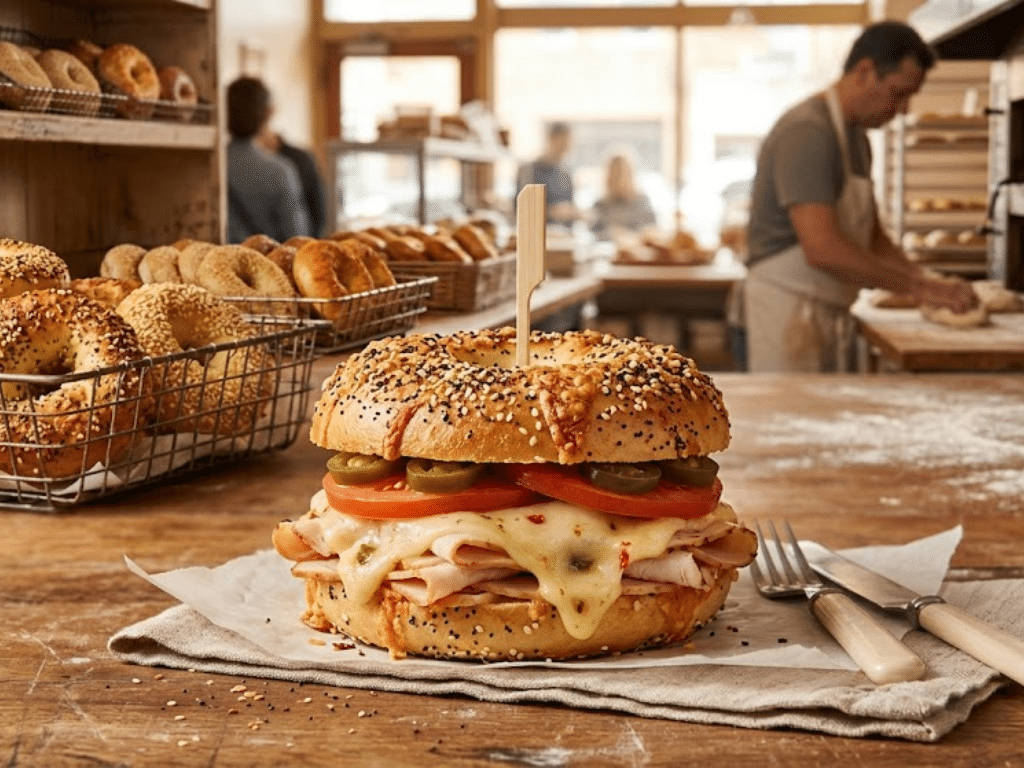
The featured order was a hot turkey sandwich served on an Everything Cheese Jalapeño Bagel.
The soft, chewy bagel was paired with turkey, pepper jack cheese, tomato, and jalapeño. The combination brought together savory flavors, a little creaminess from the cheese, and a noticeable kick from the jalapeño.
It was a fitting way to finish the visit, especially for anyone who enjoys a sandwich with plenty of flavor and a little heat.
The meal was paired with an iced matcha, rounding out the tasting experience.
Western Bagel celebrates 100 episodes of local stories
Our visit to Western Bagel was especially meaningful because it was part of the 100th episode of Eat Live Love San Fernando Valley.
Over the years, the series has highlighted local restaurants, family businesses, and the people behind them. The goal is to help more people discover the businesses that contribute to the character of the San Fernando Valley and encourage the community to support them.
Western Bagel is a great example of that story: a family business that began with one baker’s decision to bring a familiar New York food tradition to California and grew into a name recognized by generations of customers.
Visit Western Bagel in Van Nuys
If you live in the San Fernando Valley and have never stopped by Western Bagel, this is a good time to discover what the family has been making since 1947.
The Van Nuys location featured in the episode is near Sepulveda Boulevard and Stagg Street. It is open 24 hours a day, 365 days a year, according to the episode.
Western Bagel has 11 retail locations throughout Southern California, including seven in the San Fernando Valley.
Whether you are picking up a plain bagel, trying one of the specialty varieties, or ordering a sandwich, you are supporting a family business with a history spanning more than seven decades.
Watch the video: Celebrate the 100th episode of Eat Live Love San Fernando Valley with a behind-the-scenes tour of Western Bagel. Hear the family’s story, see how the bagels are made, and watch Scott try the hot turkey sandwich on an Everything Cheese Jalapeño Bagel.
Keep supporting the local businesses and family stories that make the San Fernando Valley special.
Work with Scott